
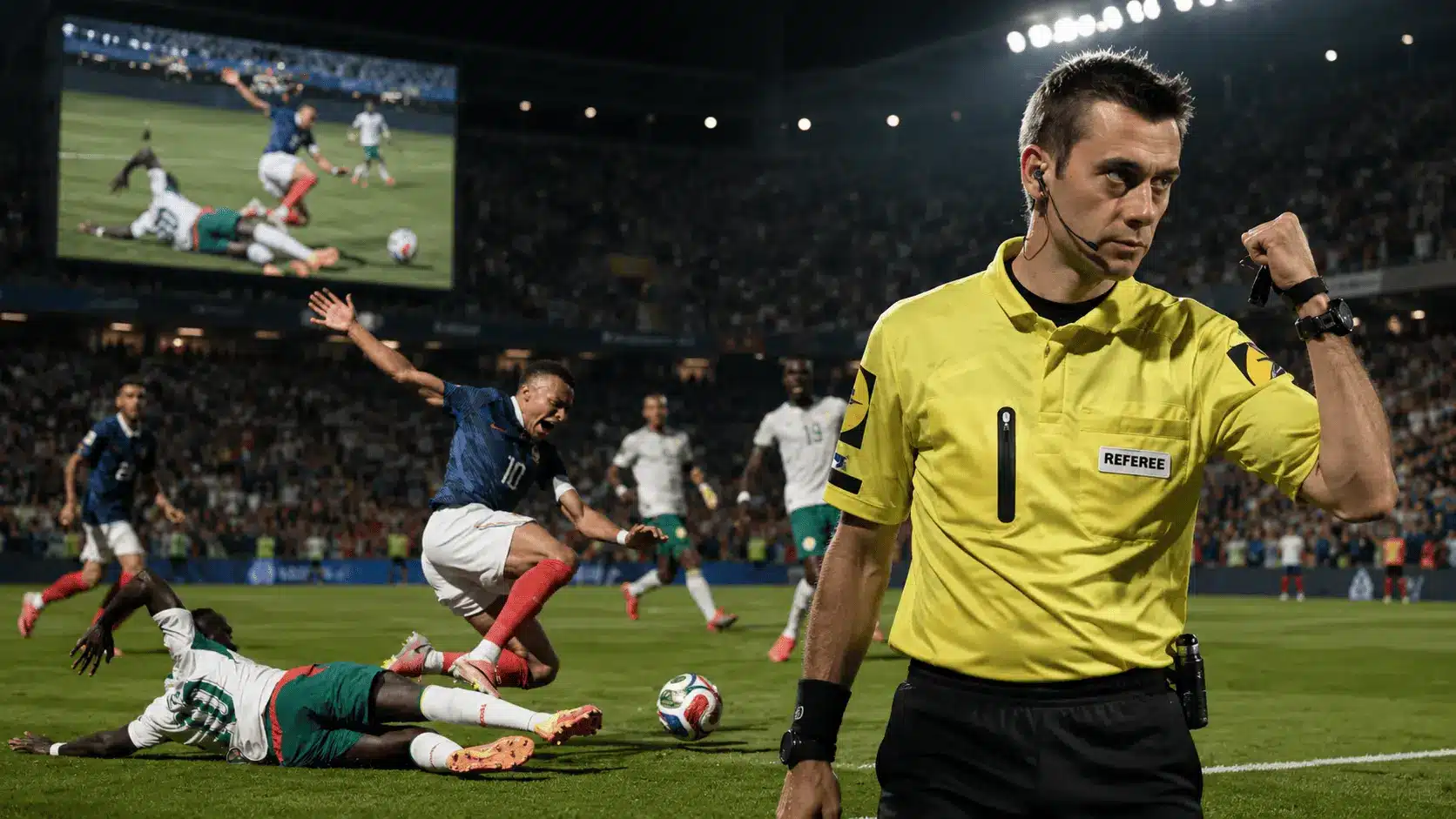
UEFA has instructed its video assistant referees (VARs) not to use mistaken identity reviews to punish players for simulation, distancing itself from a controversial interpretation of the laws that featured during the 2026 FIFA World Cup.
The directive comes after two high-profile incidents at the tournament in which VAR intervened under a recently updated protocol introduced by the International Football Association Board (IFAB).
What Changed in the VAR Protocol?
Under amendments to the VAR protocol that took effect this summer, video officials are now permitted to intervene when a referee incorrectly identifies the player responsible for an offence.
Previously, mistaken identity reviews were largely limited to cases involving red cards. However, the revised protocol allows VAR to recommend changing a yellow or red card if the referee has cautioned or dismissed the wrong player.
The new provision was activated twice during the World Cup.
USA-Paraguay Incident
The first instance occurred during the group-stage match between the United States and Paraguay.
Referee officials initially booked USA defender Tim Ream for what appeared to be a foul.
After reviewing the footage, VAR determined that Paraguay’s Miguel Almiron had actually committed simulation by diving.
The yellow card was removed from Ream and instead issued to Almiron.
Embolo Red Card Sparks Debate
The second incident proved far more controversial.
During Switzerland’s World Cup quarter-final against Argentina, referee officials initially booked Argentina midfielder Leandro Paredes for a reckless challenge.
However, a VAR review concluded that Switzerland striker Breel Embolo had initiated the contact.
Since Embolo had already been shown a yellow card earlier in the match, the new review resulted in the caution being transferred to him, producing a second yellow card and an automatic dismissal in the 72nd minute.
The decision dramatically changed the course of the contest.
It came just five minutes after Switzerland had equalised to make the score 1-1, before Argentina eventually secured a 3-1 victory after extra time to reach the semi-finals.
UEFA Takes Different Approach
Despite IFAB’s revised protocol, UEFA has now informed its match officials that simulation should not be treated as a mistaken identity offence in the same way.
The European governing body believes VAR should not use the protocol to retrospectively punish a player for diving when the referee initially penalised another player for committing a foul.
The guidance means UEFA competitions, including the Champions League, Europa League and European Championship qualifiers, are unlikely to see similar interventions.
Fresh Debate Over VAR
The World Cup incidents have reignited debate over the expanding role of VAR in football.
Supporters argue the technology should ensure the correct player is punished whenever a clear error has occurred.
Critics, however, believe extending VAR’s authority in this way risks changing the nature of matches through technical reinterpretations that were never intended when the system was introduced.
UEFA’s latest instruction suggests the organisation favours a more restrained application of the technology, even as football’s lawmakers continue refining the VAR protocol.
The differing approaches adopted by FIFA and UEFA could also fuel further discussion over how the game’s major competitions should interpret and apply the evolving Laws of the Game.