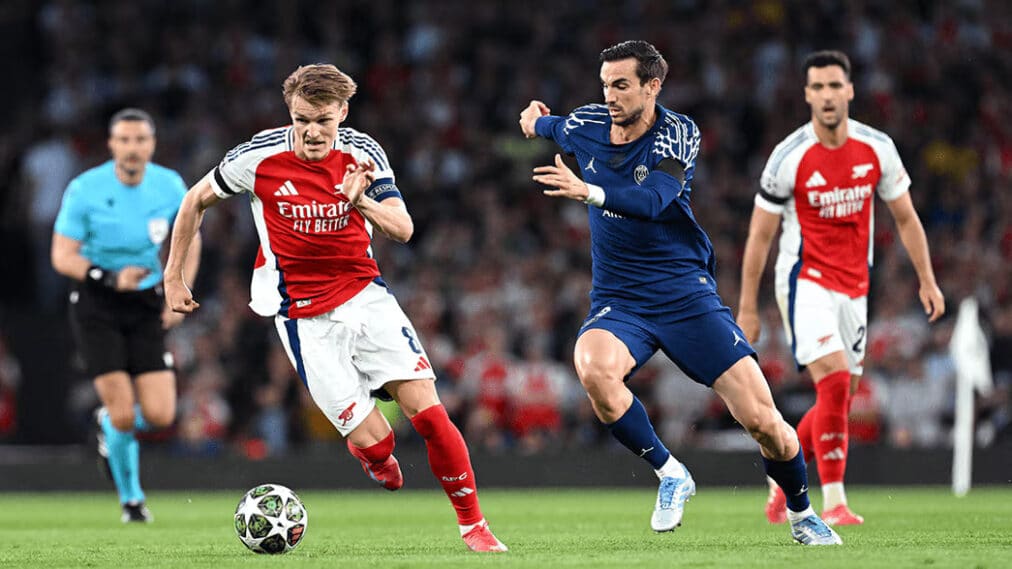
The stage is set for one of the most intriguing UEFA Champions League finals in recent memory as Paris Saint-Germain and Arsenal prepare to battle for European football’s biggest prize.
Both clubs have taken very different routes to reach Budapest, but each arrives with genuine belief that continental glory is within reach.
PSG’s Battle-Tested Journey
Paris Saint-Germain’s path to the final has been anything but straightforward.
The French champions endured a turbulent league phase, recording notable victories against Celtic, PSV Eindhoven, Benfica, Shakhtar Donetsk and Porto, while also dropping points against AC Milan and Juventus and suffering a narrow defeat to Liverpool.
Their inconsistent campaign left them 11th in the standings, forcing them into the knockout play-off round.
PSG survived a dramatic aggregate battle against Monaco before embarking on one of the toughest knockout runs seen in recent Champions League history.
Luis Enrique’s side eliminated Chelsea in the Round of 16, overcame Liverpool in the quarter-finals and then edged Bayern Munich 6-5 on aggregate in a thrilling semi-final encounter.
Having eliminated a succession of European heavyweights, PSG enter the final carrying invaluable experience from some of the competition’s toughest contests.
Arsenal’s Dominant European Campaign
Arsenal’s route to the final has been built on consistency, control and tactical discipline.
Mikel Arteta’s side produced a flawless league-phase campaign, winning all eight matches to finish top of the table with a perfect record.
Victories over Athletic Bilbao, Olympiakos, Atletico Madrid, Slavia Prague, Bayern Munich, Club Brugge, Inter Milan and Kairat highlighted Arsenal’s authority throughout the competition.
The Gunners continued their impressive form in the knockout stages, defeating Bayer Leverkusen in the Round of 16 before overcoming Sporting CP in the quarter-finals.
Their semi-final victory over Atletico Madrid further demonstrated the maturity and resilience that have become hallmarks of Arteta’s side this season.
Arsenal’s defensive solidity and midfield control have made them one of the most difficult teams to break down in Europe.
Attacking Stars Ready for the Big Stage
PSG arrive as the competition’s highest-scoring side with 44 goals.
Ousmane Dembele has been the driving force behind much of their attacking threat, while Khvicha Kvaratskhelia has consistently delivered in key knockout matches.
For Arsenal, Bukayo Saka has continued his reputation as a decisive performer in crucial moments, while Viktor Gyokeres has added goals, physical presence and relentless pressing to the team’s attack.
Key Players Who Could Decide the Final
PSG
Ousmane Dembele
The French winger remains one of Europe’s most unpredictable attacking weapons. His pace, movement and creativity can destabilize even the most organized defensive structures.
Khvicha Kvaratskhelia
The Georgian star thrives in one-on-one situations and will look to exploit any space left behind Arsenal’s defensive line.
Desire Doue
The young forward provides unpredictability and explosive attacking energy capable of changing matches in an instant.
Arsenal
Declan Rice
Many view Rice as Arsenal’s most influential player. His ability to win midfield battles, recover possession and halt counterattacks could prove decisive.
Bukayo Saka
A proven big-game performer, Saka has repeatedly delivered in crucial moments throughout Arsenal’s European campaign.
William Saliba
The French defender will carry significant responsibility as Arsenal attempt to contain PSG’s dangerous frontline.
Martin Odegaard
If Arsenal succeed in controlling possession and dictating tempo, their captain is likely to be at the heart of it.
Clash of Contrasting Styles
The final presents a fascinating tactical battle between two distinct football philosophies.
PSG rely on explosive attacking transitions, individual brilliance and experience gained through difficult knockout encounters.
Arsenal, meanwhile, have built their success on structure, discipline and collective balance.
One team thrives on moments of attacking chaos. The other seeks control through organization and possession.
With European football’s biggest trophy at stake, the contrast in styles could make for a memorable Champions League final.