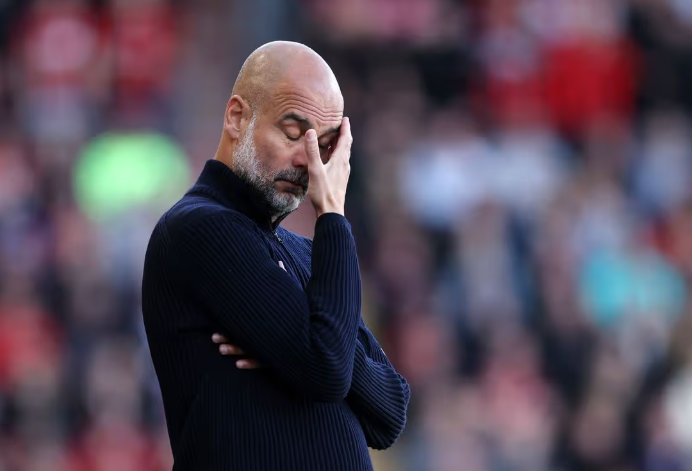
When Pep Guardiola arrived at Manchester City in 2016, English football expected success.
What nobody truly expected was total transformation.
Nearly a decade later, Guardiola’s reign at City has become one of the most dominant managerial eras the Premier League has ever witnessed a period defined not only by trophies, but by tactical revolution, relentless excellence, and a style of football that permanently altered the standards of the English game.
Six Premier League titles in ten seasons.
Four consecutive league crowns between 2021 and 2024.
Around 20 major trophies overall.
Domestic doubles.
Treble-winning glory.
Record-breaking campaigns that often felt less like title races and more like footballing exhibitions.
This was not simply dominance.
It was sustained control over an entire era.
Perhaps the clearest symbol of Guardiola’s brilliance came during the unforgettable 2017–18 season, when Manchester City became the first Premier League side to reach 100 points. That team shattered records with 106 goals scored and a staggering +79 goal difference, producing football so fluid and overwhelming that many observers immediately labeled them one of the greatest English sides ever assembled.
Yet Guardiola’s legacy at City extends far beyond numbers.
His teams changed how football in England is played and understood.
Possession football existed before Guardiola, but at Manchester City he refined it into something suffocatingly precise. Opponents were not merely beaten; they were starved of the ball, dragged out of position, and systematically dismantled through movement, pressing, and tactical flexibility.
Every season brought evolution.
Full-backs became midfielders.
Center-backs initiated attacks like playmakers.
Strikers disappeared into false-nine systems before traditional forwards returned in new forms.
Players constantly rotated positions, spaces were manipulated relentlessly, and City often appeared to control games before the opening whistle had even settled.
What made Guardiola’s reign even more remarkable was his refusal to stay static.
Many dominant teams eventually fade because rivals decode them. Guardiola avoided that trap by reinventing his side repeatedly. Injuries, aging squads, player departures, and tactical adjustments from rivals forced City into constant evolution and somehow they kept winning anyway.
The consistency became frightening.
Guardiola now holds the highest win percentage in Premier League history among managers with over 100 matches, while also becoming the fastest manager to reach 250 league victories. In an era filled with elite coaches, financially powerful clubs, and intense scrutiny, City still remained the benchmark.
Of course, discussions around his legacy have always included the immense financial backing available at Manchester City. The club’s investment allowed Guardiola to build extraordinary squads filled with world-class talent and depth.
But resources alone do not guarantee historical greatness.
Many wealthy clubs spend heavily without creating dynasties. Guardiola transformed investment into structure, identity, and sustained superiority. More importantly, he elevated coaching standards across the league. Rival managers increasingly adapted their tactics, recruitment, and player development philosophies in response to the football City were producing.
In many ways, the Premier League spent years trying to catch up with Guardiola’s ideas.
Now, however, an emotional reality is beginning to emerge around football:
the Guardiola era at Manchester City may eventually be approaching its final chapter.
That possibility alone feels strange.
For nearly a decade, Guardiola’s City have been one of the defining constants of elite football dominating weekends, rewriting records, and forcing the rest of Europe to evolve alongside them.
And if the goodbye truly is coming soon, then English football will not simply be losing a manager.
It will be saying farewell to one of the most influential football masterminds the sport has ever seen.