

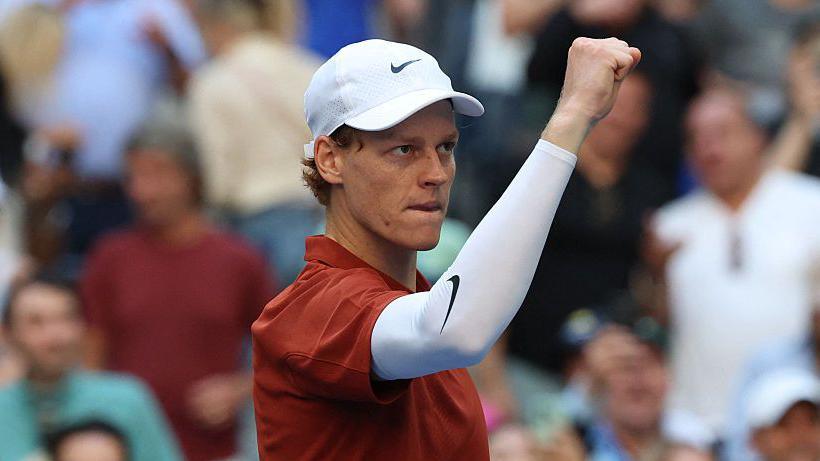
The men’s game is increasingly revolving around one dominant figure, and right now that player is Jannik Sinner.
With a string of commanding performances, the world No. 1 is not simply winning matches he is controlling them. His powerful serve, relentless first-strike tennis and remarkable composure have made him arguably the form player on tour.
Analysts point to one key trait separating Sinner from many of his rivals: consistency. While others fluctuate, his level has become strikingly repeatable, a quality often associated with long-term dominance.
Questions Around Alcaraz’s Balance
While Carlos Alcaraz remains one of the sport’s most electrifying talents, recent performances have prompted debate about his current trajectory.
Though still winning, the Spaniard has shown occasional vulnerability, dropping sets unexpectedly and at times relying heavily on improvisation over structure.
Against lower-ranked opposition, his creativity often proves decisive. Against elite opponents like Sinner, however, tactical discipline may become increasingly important.
The rivalry between the two continues to shape the ATP conversation.
Djokovic Focused on the Biggest Stages
For Novak Djokovic, the approach appears increasingly selective.
The veteran has reduced his tournament schedule, prioritizing Grand Slam preparation over week-to-week dominance—a strategy many view as legacy management at this stage of his career.
While his threat in major tournaments remains unquestioned, reduced match play has raised questions about rhythm and whether younger challengers may begin to capitalize.
Depth Fueling Unpredictability
Beyond the top names, the depth of the men’s game continues to generate volatility.
Players such as Holger Rune, Alex de Minaur and Casper Ruud are proving increasingly capable of unsettling higher seeds.
The narrowing gap between the top five and the wider top 20 has made upsets more common and tournament draws far less predictable.
For leading seeds, every round is becoming a potential test.
Świątek Leads Fierce Battle on WTA Tour
On the women’s side, Iga Świątek remains the benchmark, particularly on clay, but the competition around her is intensifying.
Aryna Sabalenka continues to bring explosive power, while Elena Rybakina remains one of the tour’s most efficient and dangerous players.
Meanwhile, Coco Gauff is evolving tactically, adding greater nuance to a game already built on elite athleticism.
The result is a women’s field where matchups, form and execution can matter as much as rankings.
A Sport Entering a New Competitive Era
Across both tours, the pattern is becoming clear: dominance exists, but certainty does not.
Sinner may be setting the standard, Djokovic remains looming, Alcaraz is still a threat, and challengers continue to deepen the field. On the WTA side, multiple contenders are pushing for supremacy.
In a sport increasingly shaped by depth, rivalries and razor-thin margins, unpredictability may be becoming the new normal.