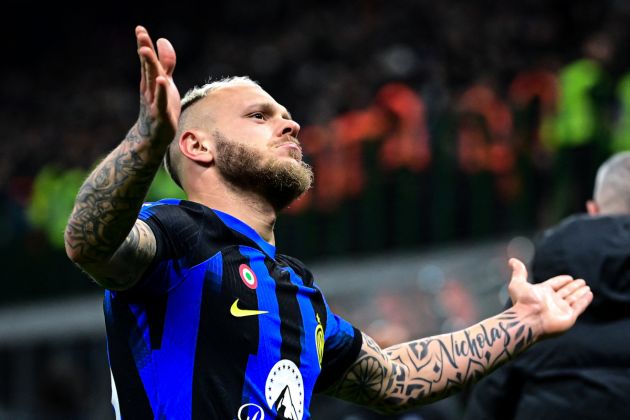
Last season, the criticism surrounding Federico Dimarco was impossible to ignore.
Questions emerged about his effectiveness:
- Had his style become predictable?
- Was he too one-dimensional?
- Could he cope defensively at the highest level?
Within Inter Milan’s demanding system under Simone Inzaghi, Dimarco’s dip in form exposed vulnerabilities. His delivery lacked its usual precision, his overlapping runs became easier to anticipate, and defensively, he faced difficult moments against elite opposition.
For a player whose attacking quality is built on precision and timing, even a slight drop carried significant scrutiny.
A season of evolution, not just recovery
Dimarco’s response this season has not simply been a return to form it has been a tactical and technical progression.
Role adjustment: beyond the touchline
Inzaghi introduced subtle but effective changes:
- Increased movement into half-spaces
- Greater involvement in midfield build-up
- Reduced reliance on traditional wide positioning
This shift added unpredictability. Rather than delivering from fixed areas, Dimarco began operating in zones that forced defenders into difficult decisions track inside or hold shape.
Improved decision-making
Where previous performances leaned toward instinctive delivery, this season has shown greater control.
Dimarco now:
- Scans before releasing the ball
- Selects moments to cross rather than forcing them
- Prioritizes quality over quantity
The result has been more impactful contributions, with assists carrying greater tactical value.
Defensive refinement
Defensive consistency had been a major point of concern. This season, there has been clear improvement:
- More effective recovery runs
- Smarter positional awareness
- Better coordination with teammates, particularly Alessandro Bastoni
While not transformed into a defensive specialist, Dimarco has reached a level of reliability essential for elite competition.
A title-winning statement
Inter Milan’s league success provided the backdrop for Dimarco’s resurgence.
His contributions throughout the campaign reflected both individual growth and collective dominance. Each assist and decisive moment reinforced a broader message his role had evolved, not diminished.
The wider lesson
Dimarco’s trajectory highlights a critical reality in modern football:
- Players identified as “predictable” must adapt
- Tactical systems demand continuous evolution
- Criticism can either define a player or refine them
Where some struggle under scrutiny, others respond with adjustment and development.
Final word
Federico Dimarco was questioned.
Then he responded.
Not with reinvention, but with refinement adding variation to his strengths and discipline to his game.
And in doing so, he transformed doubt into validation,
and potential decline into a defining chapter of his career.