
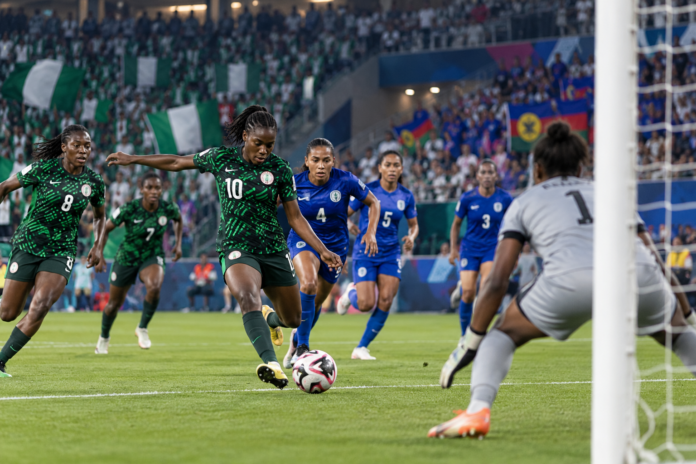
Nigeria’s Falconets may have seen their FIFA U-20 Women’s World Cup campaign come to an end, but their journey in Poland has offered plenty of reasons for optimism about the future of women’s football in the country.
The young Nigerians bowed out in the quarter-finals after a narrow 1-0 defeat to Colombia, ending a campaign that had already produced one of the tournament’s most impressive knockout-stage performances.
Before their quarter-final exit, Nigeria had announced themselves in emphatic fashion with a 3-0 victory over England in the round of 16.
It was the kind of performance that captured attention beyond Nigeria. The Falconets combined attacking purpose with defensive discipline, while goalkeeper Christiana Uzoma played a particularly important role by saving a penalty.
Tosin Rafiu opened the scoring before Seimeyeha Janet Akekoromowei doubled Nigeria’s advantage. Mary Mamudu then added a third to complete a convincing victory and send the Falconets into the last eight.
For a team carrying the expectations that traditionally accompany Nigerian women’s football, it was another reminder of the depth of talent emerging through the country’s youth system.
Yet the quarter-final against Colombia presented a different challenge.
Nigeria were unable to reproduce their attacking efficiency and ultimately paid the price for a fine margin. Colombia’s 1-0 victory brought the Falconets’ campaign to a premature end, but it did little to diminish the significance of their run.
The tournament itself has continued to produce compelling stories, with the competition now reaching its decisive stage.
Italy booked their place in the semi-finals with a 3-1 victory over South Korea, while Spain edged Brazil 1-0. Colombia joined them after eliminating Nigeria, while defending champions DPR Korea defeated Canada 2-0.
The semi-finals now pit Italy against Spain and DPR Korea against Colombia, with the winners set to meet in the final.
For Nigeria, however, the bigger story may lie beyond the result.
The Falconets’ campaign has once again placed the spotlight on a generation of players who are beginning to establish themselves on the international stage. At U-20 level, the tournament is not simply about winning a trophy; it is also one of the most important pathways through which young players gain experience against some of the world’s strongest footballing nations.
Nigeria’s victory over England demonstrated the heights this group can reach. The defeat to Colombia, meanwhile, offered another lesson about the fine margins that separate progress from elimination at the highest level.
The challenge now is to ensure that the experience does not end with the final whistle.
For the players, the next step will be about turning a promising tournament into sustained careers at senior level. For Nigerian football authorities and clubs, it is about creating the environment in which the talent showcased in Poland can continue to develop.
The Falconets have left the tournament, but their story is far from over.
If this generation can build on what it experienced in Poland, the disappointment of a quarter-final exit could eventually become an important chapter in a much bigger Nigerian football story.