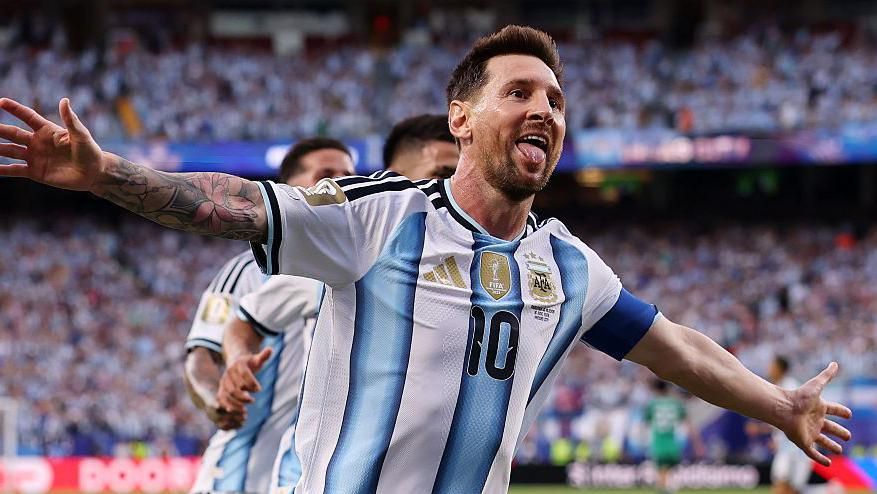
Lionel Messi continues to defy age, expectations, and football history at 38.
The Argentine captain once again proved why he remains one of the game’s greatest players after becoming the all-time leading scorer in FIFA World Cup history during Argentina’s 2-0 victory over Austria.
When Messi curled a trademark left-footed effort into the net early in the contest, it was far more than another spectacular goal. The strike saw the 38-year-old surpass every player to become the World Cup’s leading scorer, adding yet another chapter to an already extraordinary career.
He was not finished there.
The Inter Miami star added a second goal later in the game, squeezing his finish through two Austrian defenders from a tight angle to secure Argentina’s victory and maintain the defending champions’ impressive start to the 2026 tournament.
The performance continued a remarkable run of form that has made Messi one of the leading contenders for the Golden Boot. After opening the tournament with a hat-trick and following it up with another brace, the Argentine captain has firmly established himself as one of the stars of the competition.
Six Consecutive World Cup Matches
Messi has now scored in six consecutive World Cup matches, becoming only the third player in history to achieve the feat.
France’s Just Fontaine accomplished the run in 1958, while Brazil’s Jairzinho managed it during the 1970 tournament. No player has ever scored in seven straight World Cup matches, placing Messi on the verge of yet another historic milestone.
The Argentine legend is also closing in on another record. Already the player with the most chances created in World Cup history, Messi is one assist away from becoming the outright leading creator since records began in 1966.
He currently shares that mark with Argentine icon Diego Maradona, the man many considered his greatest predecessor.
How Has Messi Stayed at the Top?
The emergence of younger stars such as Kylian Mbappe, Erling Haaland and Vinicius Junior has led many to believe football’s balance of power was shifting.
Yet Messi has once again demonstrated that experience, intelligence and technical brilliance can still overcome youth and athleticism.
His game has evolved significantly over the years. While he no longer relies heavily on explosive acceleration, his movement, positioning and decision-making remain exceptional.
Messi carefully conserves energy during matches, choosing the right moments to attack and often drifting into pockets of space where he can influence the game with a single touch or pass.
His understanding with Argentina’s attacking players, combined with his ability to read the game several steps ahead of opponents, allows him to remain decisive even at the age of 38.
Chasing More History
Messi turns 39 this week, yet he continues to perform at a level few thought possible.
With Argentina already looking strong in their bid to defend the World Cup title and a final group match against Jordan still to come, the possibility of further records appears increasingly realistic.
A Golden Boot, a seventh consecutive scoring match and perhaps another World Cup trophy are all still within reach.
For a new generation of football superstars, the challenge remains clear: if they want to become the face of world football, they must first dethrone the man who continues to define it.
At 38, Lionel Messi is not simply extending his career.
He is extending his reign.